
SPOT: Know When to Reach In | 082326

What two lifts with my son taught me about struggle, fatherhood, responsibility, and wisdom
A few years ago, I was chasing a bench press PR.
I'd been training heavy for a couple of months—mostly doubles and triples—and things were clicking.
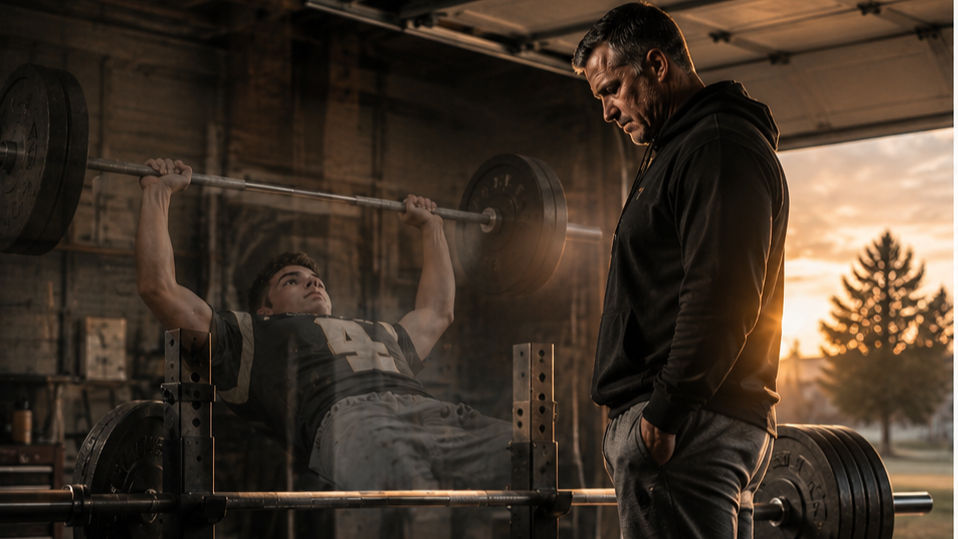
One morning in the garage, with my son Damian training alongside me, I loaded 345 pounds onto the bar.
I'd actually already hit it once. Clean lift.
The only problem? My phone had fallen over. Didn't record a second of it.
So naturally, I decided I needed to do it again.
I set the phone back up. Damian stood behind the bench. I unracked the bar, lowered it to my chest, and pressed.
It wasn't fast. But it was moving.
Then—
CLANG.
I clipped one of the J-hooks.
The bar shifted. My momentum changed.
I saw Damian's eyes get wide. His hands came forward immediately.
But he didn't touch the bar.
He stayed ready and let me fight.
I pushed through it, locked the bar out and racked it.
345.
Again.
I'm grateful he didn't take that rep away from me.
Because Damian understood something important about spotting:
His job wasn't to make sure I never struggled. His job was to make sure I could struggle safely.
THE OTHER SIDE OF THE BAR
Another day, our positions were reversed.
Damian was probably a senior in high school. We were doing back squats in the garage—five sets of five.
We were still warming up and hadn't even reached two plates.
I was behind him.
Technically, I was spotting him. But I wasn't really spotting him. Not the way I should have been.
I'd watched him squat countless times. This was warm-up weight. Somewhere in my head, I decided the rep didn't require my full attention.
I was wrong.
Coming out of the bottom, his hips suddenly rose faster than his torso. He pitched forward and the weight took over.
It happened fast.
I reacted, got underneath him and tried to help. But I was late.
The bar rolled over his head and crashed onto the floor in front of him.
I was terrified.
I remember standing over my son and that bar, checking him, asking if he was okay, and saying one of those little prayers that doesn't require any preparation:
God, please let him be okay.
Thank God he was.
Damian blamed himself. He said he'd lost focus and bailed badly.
And he was right about his part.
But I knew something else.
His mistake was his. Mine was mine.
I was his spotter. And I wasn't ready when he needed me.
I've never forgotten it.
SOMETIMES STRUGGLE IS THE REP
A spotter has a strange job.
You stand inches away from someone deliberately doing something difficult, and your responsibility isn't to make it easy.
You don't grab the bar the second it slows down. You don't rescue someone from every sticking point. Sometimes you watch somebody you care about struggle.
That's particularly difficult as a father.
We want to reach in.
Fix it. Protect them. Keep them from getting hurt.
But protecting our children doesn't always mean removing their struggle.
Sometimes struggle is exactly what they need.
Sometimes struggle is the rep.
It's where strength gets built.
If Damian had grabbed my bench press the moment I clipped the J-hook, he would have protected me from a failure that hadn't happened.
I was still in the lift.
But there's another side to that responsibility.
Sometimes the bar isn't merely moving slowly. Sometimes the lifter has lost it.
That's when you reach in.
The difficult part is knowing the difference.
I NEED WISDOM FOR BOTH
I've thought about that distinction more as my children have gotten older.
There are plenty of things I'd love to protect them from.
Failure. Disappointment. Bad decisions. Consequences. Heartbreak.
But I can't spot their lives by grabbing the bar every time a rep becomes difficult.
They need their own reps.
At the same time, being willing to let someone struggle doesn't mean looking away.
So I find myself asking:
Is this something I'm supposed to step into? Or something I need to trust them to work through? Is this struggle making them stronger? Or has it become something they genuinely need help getting out from under?
For me, that's become a faith question.
James 1:5 says:
“If any of you lacks wisdom, let him ask of God.”
I do.
Because I don't always know when to keep my hands off the bar.
And I don't always know when it's time to reach in.
I need wisdom for both.
My children aren't mine to control. They've been entrusted to me.
To love. Guide. Teach. Protect. And eventually, let go.
Sometimes I need God to show me which one He's asking of me.
DON'T FALL ASLEEP AT THE WHEEL
There's another side of spotting that I don't want to miss.
When someone asks you to spot them, they're trusting you.
They're essentially saying:
I'm about to put myself in a position where I might not be able to get out by myself. Stay close.
That's a responsibility.
And maybe someone has trusted you that way outside the gym too.
Your child finally tells you what's really going on.
Your spouse tells you she's struggling.
Your brother admits he isn't doing well.
Your friend calls because something has become too heavy.
You don't necessarily grab the bar.
Stay close. Listen. Pay attention. Pray.
Let them do the work that's theirs to do.
But if somebody has trusted you enough to put you behind the bar:
Don't fall asleep at the wheel.
Be there.
KNOW WHEN TO REACH IN
I've been on both sides of the bar.
I've had someone stand behind me and trust me enough to let me struggle.
And I've stood behind somebody I love and learned what can happen when I'm not paying enough attention.
Maybe that's what being a good spotter really means.
Don't lift everybody else's weight.
Don't rescue them from every hard rep.
Don't mistake struggle for failure.
Stay close. Pay attention.
Let them struggle when the struggle is making them stronger.
And ask God for the wisdom to recognize the moment when struggle becomes danger.
Because when that moment comes...
reach in.
Damian taught me both lessons.
One day by keeping his hands off the bar.
And another by reminding me why mine needed to be ready.
Funny how sometimes the people you're supposed to be teaching...
end up teaching you.
Today's lesson came from a spot.
Next week, we'll see what else the gym has to teach us.
The work continues.


Comments